
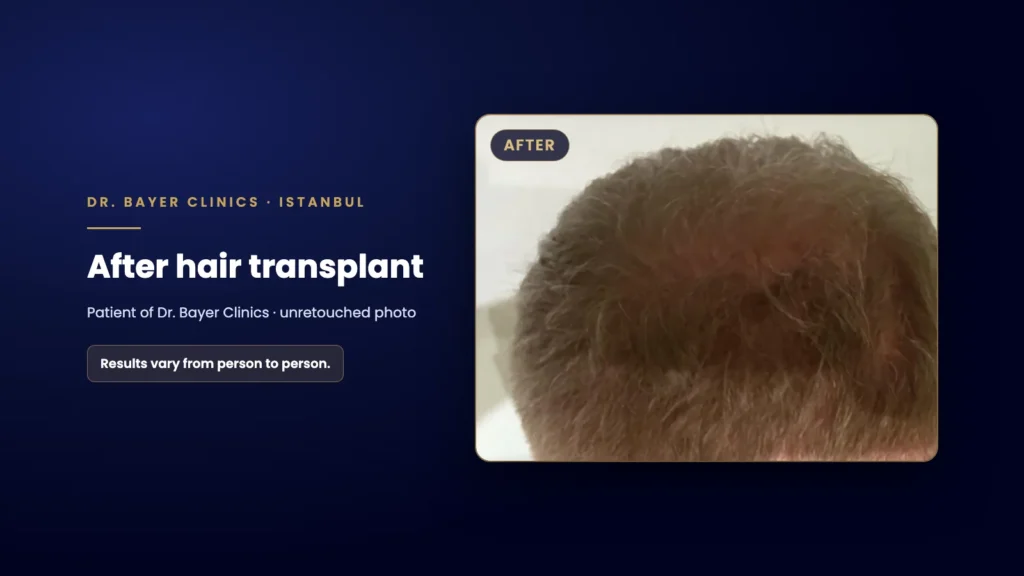
No single clinic is right for everyone. The right choice in Turkey depends on the cause of your hair loss, your donor area and your goals, so run 12 checks before you book: who your physician is, who performs each stage, the clinic’s official authorisation, and how planning and aftercare work.
Below you will find the 12 checks in a quick table, a closer look at each one, the red flags worth knowing, what safety depends on, and a short description of how our own clinic works, so you can compare clinics on the same terms.
What “best hair transplant in Turkey” should mean for you
Search results and adverts can make it look as if one clinic suits everyone. Medically, that is not how it works. A good outcome depends on a correct diagnosis, a realistic plan for your donor hair, a physician who makes the surgical decisions, careful technique and proper aftercare. Two people with the same budget and the same flight can need very different plans.
Planning also has to look ahead. The NHS points out that the hair around a transplanted area may continue to thin, so a design that looks right today should still make sense in years to come. The useful question, then, is whether a clinic can answer the checks below clearly, in writing, before you travel.
The 12 checks at a glance
| Check | What to ask | A reassuring answer |
|---|---|---|
| 1. The physician | Who examines me and leads my procedure? | A named physician whose qualifications you can check |
| 2. Who does each stage | Who designs, extracts and opens the channels? | A stage-by-stage answer that names the physician for the key surgical steps |
| 3. Official authorisation | Do you hold the Ministry of Health authorisation for international patients? | Yes, with a certificate number |
| 4. Training and membership | Where did the physician train, and which societies do they belong to? | Details you can verify, such as an ISHRS directory listing |
| 5. Medical assessment | Will you look at the cause of my hair loss? | Photos reviewed first, then an examination before surgery |
| 6. Grafts and donor reserve | How many grafts, and what is left for later? | A range, explained against your donor area |
| 7. Choice of method | Why FUE or DHI for me? | A reason based on your hair and goals |
| 8. Hairline and angle | Who draws the hairline, and how are channels angled? | The physician, matched to your face and hair direction |
| 9. Daily workload | How many procedures happen on the same day? | A number that leaves the physician time for each patient |
| 10. Written quote | What is included, item by item? | A written, itemised quote after photo review |
| 11. Follow-up | How will you follow my recovery at home? | Set photo check-ins and a named contact |
| 12. Complications | Who do I contact if something goes wrong? | A direct contact and honest limits on what surgery can do |
The 12 checks explained
1. Who is the physician, and who examines you?
Ask for the name of the physician who will examine you and lead the procedure, and make sure you will meet them before surgery, not only a coordinator. The NHS suggests asking about the surgeon’s qualifications and how many procedures they have carried out, including how many had complications.
2. Who performs each stage?
A hair transplant has several stages: examination, planning, hairline design, graft extraction, opening the channels, placing the grafts and aftercare. The International Society of Hair Restoration Surgery (ISHRS) stresses that hair restoration in any form is surgery, and that examination, diagnosis, planning, the procedure and the management of complications should be carried out by a physician. It also warns that procedures performed by unlicensed technicians carry serious risks. Ask the clinic to tell you, stage by stage, who will do what on the day.
3. Is the clinic officially authorised?
In Turkey, the Ministry of Health issues an International Health Tourism Authorisation Certificate to health facilities authorised to serve international patients. Ask for the certificate number and the name of the facility it belongs to, and check that it matches the clinic where you will actually have surgery. Our certificate number is ST-2237.
4. What training and memberships does the physician have?
Ask where the physician studied medicine, how they trained in hair restoration and which professional societies they belong to. Membership claims can be checked: ISHRS membership, for example, can be confirmed in the society’s physician directory. A membership is not proof of skill on its own, but it is a detail you can verify. Vague claims are not.
5. Will you have a medical assessment before the procedure?
Before giving you a quote, a clinic should review clear photos of your scalp and ask about your health and the history of your hair loss. Not every kind of hair loss suits a transplant: the NHS notes that it is suitable for hereditary baldness, but generally not for conditions such as alopecia areata. An examination before surgery then confirms or adjusts the plan made from your photos.
6. Is the graft plan realistic, and what about your donor reserve?
Your donor area is limited, and hair used today cannot be used again later. A sensible plan gives the number of grafts as a range, shows which areas they will cover and explains how much donor hair will be left if your hair loss continues. Our guide on how many grafts you may need explains how this estimate is made.
7. Why this method for you?
FUE and DHI share the same basic idea of moving follicular units from the donor area; they differ mainly in how the grafts are placed. The NHS recommends asking which method is recommended for you and why. Expect a reason based on your hair type, the area to cover and your goals, not one method sold to everyone. Our comparison of FUE and DHI sets out the differences.
8. Who designs the hairline, and how are the channels angled?
The hairline frames your face for years, so ask who draws it, how it is adapted to your face and age, and whether it allows for future hair loss. The angle and direction of the channels also influence how the new hairs lie. Our article on the oblique channel technique explains why channel angle matters. Whatever approach a clinic uses, it should be able to tell you why.
9. How many patients does the clinic treat each day?
Ask how many procedures take place on the same day, how many of them the same physician is responsible for, and whether the physician will be present for the stages they said they would do. There is no single correct number. The answer should make it clear that the physician has time for each patient’s surgical steps.
10. Is the quote written, itemised and clear about what is included?
A clear quote comes in writing, after your photos have been reviewed, and lists each item. Compare quotes on the same points: consultation and medical examination, pre-operative tests, the procedure, hotel nights, airport transfers and transport within Istanbul, medication and the first wash. Check whether flights are included. With ours, they are not.
11. How will follow-up work after you fly home?
Most of your recovery happens after you return home. Ask how the clinic will follow you up: when it will ask for photos, who reviews them and how quickly you can expect a reply. The NHS advises asking what follow-up is available if something goes wrong. Our hair transplant recovery timeline shows what to expect month by month.
12. Who do you contact if there is a complication, and what can you expect?
The NHS lists bleeding, infection and an allergic reaction to the anaesthetic among the risks, and notes that a transplant may not take. A review in the Journal of Cutaneous and Aesthetic Surgery describes hair transplantation as relatively safe, with few complications, most of which can be prevented or reduced with correct technique and wound care. The same review notes that counselling and planning before surgery help to avoid dissatisfaction. Ask for a direct contact for urgent questions, and expect an honest answer about what surgery can and cannot do. No clinic can promise you a specific density or result.
Red flags to watch for
- A promised density or result: no one can promise how your hair will grow, and results vary from person to person.
- “Scarless” or “done entirely by machine”: ISHRS states that claims of scarless or fully machine-performed transplants are false.
- Technicians doing the surgery alone: if no physician is involved in the surgical steps, or nobody will tell you who will operate, treat it as a serious warning.
- Pressure to book quickly: deadlines, or a request for a deposit before anyone has looked at your photos.
- No medical questions: a quote given without photos or a health history.
Is a hair transplant in Turkey safe?
A hair transplant in Turkey can be safe when the clinic is properly authorised and physician-led, but safety depends on the clinic, not the country. The 12 checks above cover most of it; these are the points patients most often forget to ask about:
- Medical screening: tell the clinic about conditions such as diabetes, high blood pressure, heart disease or a tendency to bleed, and about every medicine and supplement you take. Do not stop or change any of them yourself; that decision is the physician’s.
- Hygiene and infection control: ask how instruments are sterilised and how the procedure room is prepared. A clinic should be able to answer plainly.
- A written plan, not only a quote: the estimated graft range, the zones to be treated and your aftercare instructions should be in writing before the day of surgery.
- Aftercare you can follow at home: a wash schedule, a list of what is normal and what is not, and a named contact. Increasing pain, spreading redness, warmth, discharge or fever are reasons to contact the clinic at once.
- Realistic timing: transplanted hairs usually shed in weeks 2 to 8 and new growth starts from about month 3; the result is usually judged at around 12 months, and up to 18 months for the crown. Shedding in the first weeks does not mean the procedure has failed. Our recovery timeline goes through it month by month.
How our clinic works
Dr. Yetkin Bayer is a physician who graduated from Trakya University Faculty of Medicine and began working in hair transplantation in the United States in the mid-1990s. He has been a member of ISHRS since 2016. Dr. Yetkin Bayer Clinics is in Ulus, Beşiktaş, Istanbul. It holds the Ministry of Health International Health Tourism Authorisation Certificate ST-2237, and the Ministry has authorised its hair transplant training programme, approved in 2025. Grafts are taken with FUE, and the hairline is planned by the physician at the examination, together with the patient. For international patients, the package includes consultation and medical examination, pre-operative tests, the procedure, three hotel nights, airport transfers and transport within Istanbul, medication and the first wash. Flights are not included, and a written, itemised quote is given after your photos have been reviewed.
If you are still at the research stage, our overview of hair transplant in Turkey walks through the process from the first photos to the flight home. If you would like your own case assessed against these checks, you can send photos for an online assessment through our consultation form.
Frequently asked questions
How do I choose a hair transplant clinic in Turkey?
Check who the physician is and which stages they perform, the clinic’s Ministry of Health authorisation, the medical assessment, the graft plan and the written quote. Compare clinics on the same checks rather than on adverts.
Is it safe to have a hair transplant in Turkey?
It can be, when the clinic holds the Ministry of Health International Health Tourism Authorisation Certificate, a physician leads the surgical steps and follow-up continues after you fly home. Safety depends on the clinic, not the country.
Should the physician perform the hair transplant?
ISHRS states that hair restoration is surgery and that examination, diagnosis, planning, the procedure and the management of complications should be carried out by a physician. Ask which stages your physician will carry out personally.
How can I check a clinic’s authorisation in Turkey?
Ask for the number of its International Health Tourism Authorisation Certificate, issued by the Ministry of Health. Make sure the certificate belongs to the facility where you will be treated.
Can a clinic promise a hair transplant result?
No. Results vary from person to person, and the NHS notes that a transplant may not take and that the surrounding hair can keep thinning.
Are flights included in a hair transplant package?
It depends on the clinic, so ask for a written, itemised quote. In our package, flights are not included.
Sources
- International Society of Hair Restoration Surgery (ISHRS). Consumer alert. ishrs.org
- NHS. Hair transplant. Page last reviewed 29 September 2023. nhs.uk
- Kerure AS, Patwardhan N. Complications in hair transplantation. Journal of Cutaneous and Aesthetic Surgery. 2018. PubMed

This article is for general information only and does not replace a medical examination. Results vary from person to person; please consult your physician before any procedure.
