
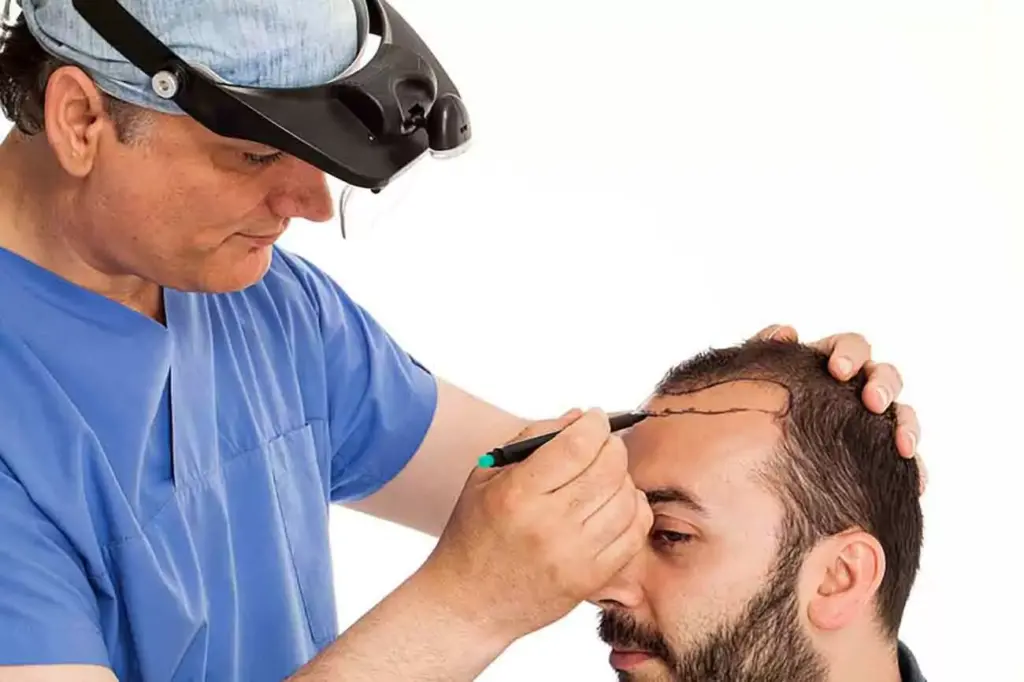
Two people can receive the same number of grafts and end up with very different results. One looks natural from every angle; the other looks thin, “pluggy” or as if the hairs are standing straight up. In most cases the difference is not the graft count. It is the angle and direction in which each graft was placed.
At Dr. Yetkin Bayer Clinics this part of the procedure is called the oblique channel technique. Below we explain what it means, why the angle of each channel matters, and what you can ask any clinic before you book.
What is the oblique channel technique?
In an FUE hair transplant, grafts are taken from the donor area and placed into tiny openings in the thinning area. These openings are called channels or recipient sites. The oblique channel technique means that each channel is opened at an acute (oblique) angle to the scalp, following the direction in which your own hair naturally grows, instead of being opened straight down.
A transplanted hair will always grow out in the direction of its channel. If the channel is opened at the right angle, the new hair lies in the same direction as the surrounding hair and blends in. If the channel is too steep, the hair grows upwards, catches the light and looks artificial.
Why the angle of each channel matters
- Natural appearance: hair that exits the scalp at a low angle overlaps the hair in front of it, which is how a natural hairline looks.
- Visual density: hairs that lie flatter cover more scalp. With the right angle, the same number of grafts can look fuller.
- Styling: when the direction matches your existing hair, you can comb and style the transplanted area the same way as the rest of your hair.
- Avoiding the “grass” look: hairs implanted perpendicular to the scalp tend to stand up and look like a lawn, which is one of the most common reasons patients are unhappy with an older transplant.
How the channels are planned
The scalp does not have one single hair direction. Before the procedure the angles are planned zone by zone:
- Hairline: hairs usually point forward at a low angle; the front row uses mostly single-hair grafts for a soft transition.
- Frontal and mid-scalp area: the direction gradually turns towards the natural parting and the way you comb your hair.
- Temples: hairs lie very flat and point downwards and backwards, so the angle here is especially low.
- Crown: hairs grow in a spiral (whorl) pattern, so channel directions follow the curve of the whorl.
Channel size and depth are matched to the graft size. One-hair grafts go to the front, while two- and three-hair grafts are used behind the hairline to build density.
Who opens the channels?
Channel opening is one of the steps that most affects the final look, so it is worth knowing who performs it. According to our clinic’s protocol, Dr. Yetkin Bayer personally designs the hairline, performs the FUE extraction and opens the channels using the oblique technique, working together with his medical team for the other steps of the procedure. Dr. Bayer has worked in hair transplantation since the mid-1990s, first in the United States and later in Istanbul, and has been a member of the International Society of Hair Restoration Surgery (ISHRS) since 2016.
Oblique channels with FUE and DHI
The same principle applies whichever implantation method is chosen. With classic FUE, the channels are opened first and the grafts are placed into them. With DHI, an implanter pen opens the channel and places the graft in one movement, but the pen still has to be held at the correct angle and direction. In both cases the angle is decided by the person creating the channel, not by the technique name.
The oblique approach is also used for beard and eyebrow transplants, where hairs lie almost flat against the skin, and for unshaved hair transplants, where new grafts have to follow the existing hair exactly.
Questions to ask any clinic
- Who will open the channels: the doctor or a technician?
- How are the angles planned for the hairline, temples and crown?
- Which graft sizes will be used in the front row?
- Can you show results photographed from the side, where the angle of the hair is visible?
- How many patients does the team operate on per day?
For more on comparing clinics, see our guide on how to choose a hair transplant clinic in Turkey.
Frequently asked questions
Is the oblique channel technique a different operation from FUE?
No. It is a way of performing the channel-opening step of an FUE or DHI hair transplant. The grafts are still harvested with FUE; what changes is the angle and direction of each channel.
Does opening channels at an angle cause more scarring?
The channels are tiny and heal within days. The angle does not make them larger; it only changes the direction in which the hair grows.
Can a previous transplant with wrong angles be improved?
In many cases new grafts can be placed at natural angles in front of and between the old ones to soften the look. Whether this is possible depends on your remaining donor area and is decided after an examination.
How do I find out how many grafts I need?
Send clear photos of your head from the front, top, back and sides. The team will assess your hair loss and donor area and suggest a plan. You can read more in how many grafts do I need?
This article is for general information only and does not replace a medical examination. Results vary from person to person; please consult your physician before any procedure.


