
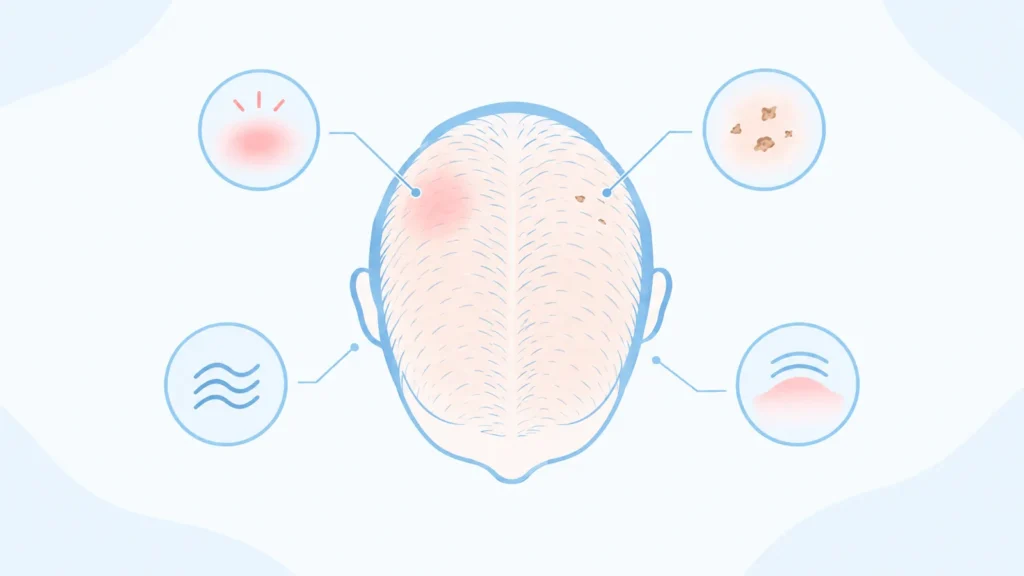
Cover image generated with AI.
Most side effects in the first weeks after a hair transplant are an expected part of healing: a tight, sore or swollen scalp for a few days, redness, scabs, itching, some numbness and temporary shedding. Pain that keeps getting worse, redness that spreads, warmth, discharge or fever are warning signs, and your clinic should hear about them straight away.
This guide goes through the common hair transplant side effects one by one, with a table of what is usually normal and when to contact your clinic, a timeline for the first weeks and a summary of what published reviews say about complications.
Why do side effects happen after a hair transplant?
A hair transplant is surgery, even though it is done under local anaesthesia and you usually return to your hotel the same day. With follicular unit extraction (FUE), individual grafts are taken from the donor area, usually the back and sides of the head, and placed into small channels opened in the thinning area. The hairline is planned by the physician at the examination, together with the patient, and the channels can be opened with the oblique channel technique. Ask the clinic who will carry out each stage on the day.
Every extraction point and every channel is a tiny wound, so the donor and recipient areas heal at the same time: the skin swells a little, turns pink, forms crusts and then repairs itself. The NHS notes that the grafts are not fully settled in the first two weeks, so this is when you need to be most careful.
What is usually normal in the first weeks?
Swelling
The NHS describes the scalp as feeling tight, sore and swollen for a few days after the procedure. Some people also notice mild swelling of the forehead around days 2 to 3; it usually goes down within a few days. Swelling that keeps increasing after the first few days, or that comes with warmth, pain or fever, should be checked by your clinic.
Redness
The treated area usually looks pink or red in the first days, and the colour fades gradually as the skin heals; how long this takes varies from person to person. Redness that spreads beyond the treated area or feels hot to the touch is not part of normal healing.
Scabs and crusting
Small crusts form around the grafts and are described by the NHS as temporary. The first wash is usually done at the clinic between day 1 and day 3. After that, gentle daily washing softens the crusts, and most of them fall off between days 7 and 10. Do not pick or scratch them, because the grafts are still settling. Our article on spraying saline after a hair transplant explains how saline fits into early aftercare. Thick crusts with discharge, or bleeding that does not stop, are reasons to contact the clinic.
Itching
Many people feel some itching as the crusts loosen. Try not to scratch, as this can disturb grafts in the first two weeks, and ask your clinic what you can use if it bothers you. Itching with a spreading rash or new swelling should be reported.
Numbness and tingling
Reduced sensation, tingling or numbness in the donor or recipient area is common in the early period. It usually improves gradually over the following weeks or months. A 2025 scoping review lists long-lasting numbness among the complications reported in the literature, so if the numbness is not improving, mention it at your follow-up rather than waiting.
Soreness and tenderness in the donor area
The donor area often feels sore or tender for the first few days, and this should ease day by day. Pain that builds after the first days, or severe pain at any point, is a reason to call the clinic.
Pimples and folliculitis
As new hairs grow through the skin, some people get small pimple-like spots in the recipient area. The 2025 scoping review lists sterile folliculitis, meaning inflamed follicles without infection, among the more frequently reported effects. Our article on pimples after hair transplant surgery covers these spots in more detail. Spots that are painful, swollen, spreading or filled with pus, especially with fever, need to be seen.
Temporary shedding (shock loss)
Between weeks 2 and 8, many of the transplanted hairs fall out. This is expected: the NHS explains that transplanted hair often falls out after a few weeks and then grows back, and new hair usually starts to appear from around months 3 to 4. Some people also notice temporary thinning of their existing hair around the treated area or in the donor area; the 2025 scoping review lists this shedding, called effluvium, among reported effects. Tell your clinic if you notice it.
Small scars
The NHS lists small scars among the possible effects of a hair transplant, and in the 2025 meta-analysis scarring was the most frequently reported problem in the recipient area. How visible any marks are depends on how your skin heals, the technique and how short you keep your hair.
Usually normal or contact your clinic?
The table below is a quick reference for the first weeks. It does not replace the written aftercare instructions from your own clinic.
| Symptom | Usually normal | Contact your clinic |
|---|---|---|
| Swelling | Mild forehead swelling around days 2–3, settling within days | Swelling that keeps increasing |
| Redness | Pink treated area, fading gradually | Redness that spreads or feels hot |
| Scabs | Small crusts, mostly shed by days 7–10 | Crusts with discharge or bleeding |
| Itching | Mild itching as crusts loosen | Itching with a rash or swelling |
| Numbness | Reduced feeling that slowly improves | Numbness that is not improving |
| Donor tenderness | Soreness easing over the first days | Pain getting worse, not better |
| Pimples | A few small spots as new hairs grow | Painful, swollen spots or pus |
| Shedding | Transplanted hairs falling out in weeks 2–8 | Thinning of your existing hair |
| Fever or discharge | Not expected | Contact the clinic straight away |
When should you contact your clinic?
The NHS advises contacting the clinic straight away if you have severe pain or any symptom you did not expect. These are the signs that need a call or a message with photos:
- Increasing pain: soreness that builds instead of easing.
- Spreading redness or warmth: redness moving beyond the treated area, or skin that feels hot.
- Discharge: pus, coloured fluid or an unpleasant smell from the donor or recipient area.
- Fever: a raised temperature, chills or feeling generally unwell.
- Bleeding: bleeding that does not stop or keeps coming back.
If you have already flown home, send clear photos to the clinic that performed your procedure and say when the symptom started. If you have difficulty breathing, swelling of the lips or tongue, or feel very unwell, seek urgent medical care where you are first, then let the clinic know.
A typical timeline for the first weeks
- Day of the procedure: the transplant is done under local anaesthesia and you usually return to your hotel the same day. The scalp may feel tight and sore.
- Days 1 to 3: the first wash is usually done at the clinic. Mild forehead swelling may appear around days 2 to 3.
- Days 7 to 10: most crusts fall off with gentle daily washing. Many people with office jobs return to work after about a week, although the NHS notes you may need 1 to 2 weeks off.
- Weeks 2 to 8: temporary shedding of the transplanted hairs.
- Throughout the first month: direct sun on the scalp is not recommended in the first weeks. Heavy exercise and heavy sweating are usually postponed for about a month, and so are saunas and swimming pools; the NHS also suggests reducing exercise in the first month. For clothing in the first days, see our guide on what to wear after a hair transplant.
- Months 3 to 4 onwards: new hair begins to grow. The NHS gives 10 to 18 months for full results.
What happens after the first weeks, month by month, is covered in our hair transplant recovery timeline.
How common are complications? What the research says
Serious complications are uncommon, but no surgery is without risk. A 2025 scoping review in Aesthetic Plastic Surgery reported overall complication rates of 1.2% and 4.7% in two large case series, and noted that serious complications are rare in experienced hands. The same review found that scabbing, forehead oedema and sterile folliculitis in the recipient area are frequently reported, but that studies define and measure them in very different ways, so their rates vary widely.
A 2025 systematic review and meta-analysis of 45 studies found that pain, swelling and oedema in the donor area were the most frequently reported problems, while scarring was the most common in the recipient area; overall, the authors described hair transplantation as generally safe.
The NHS lists bleeding, infection and an allergic reaction to the anaesthetic among the risks. It also points out that a transplant may not take, and that hair around the transplanted area can keep thinning, so the design should allow for future hair loss. These figures come from published series, not from any single clinic; your own risk depends on your health, your scalp and how the procedure is planned and carried out.
What helps the healing go smoothly?
A 2018 review described hair transplantation as relatively safe, with few complications, most of which can be prevented or reduced with correct technique and good wound care; it adds that counselling and planning before the procedure help prevent dissatisfaction. In practice, that means following your clinic’s written aftercare instructions, washing gently, leaving the crusts alone and sending photos whenever something looks different from what you were told to expect.
If you are still at the planning stage, our guide to how many grafts you may need explains how graft estimates are made. If you would like to know how recovery might look in your own case, you can send photos for an online assessment through our consultation form.
Frequently asked questions
Is it normal to have swelling after a hair transplant?
Yes, mild swelling is common. It often appears on the forehead around days 2 to 3 and usually settles within a few days. Swelling that keeps increasing, or that comes with fever, warmth or discharge, should be checked by your clinic.
How long does numbness last after a hair transplant?
It varies from person to person. Reduced feeling in the donor or recipient area usually improves gradually over weeks to months. Long-lasting numbness has been reported in the literature, so mention it at your follow-up if it is not improving.
Why is my transplanted hair falling out?
Shedding of the transplanted hairs between weeks 2 and 8 is expected. New hair usually starts to grow from around months 3 to 4.
When should I worry about pimples after a hair transplant?
A few small spots as new hairs grow through are common. Contact your clinic if the spots are painful, swollen, spreading or filled with pus, or if you have a fever.
When can I go back to work after a hair transplant?
Many people with office jobs return after about a week, while the NHS notes you may need 1 to 2 weeks off. Physically demanding work may need longer, because heavy exercise and sweating are usually postponed for about a month.
Sources
- NHS. Hair transplant. nhs.uk. Page last reviewed 29 September 2023. NHS website
- Liu RH, Xu LJ, McCarty JC, et al. A scoping review on complications in modern hair transplantation: more than just splitting hairs. Aesthetic Plastic Surgery. 2025. PubMed
- Khatib M, Skorochod R, Wolf Y. Complications following hair transplantation: a systematic literature review and meta-analysis. Aesthetic Plastic Surgery. 2025. PubMed
- Kerure AS, Patwardhan N. Complications in hair transplantation. Journal of Cutaneous and Aesthetic Surgery. 2018. PubMed

This article is for general information only and does not replace a medical examination. Results vary from person to person; please consult your physician before any procedure.
