
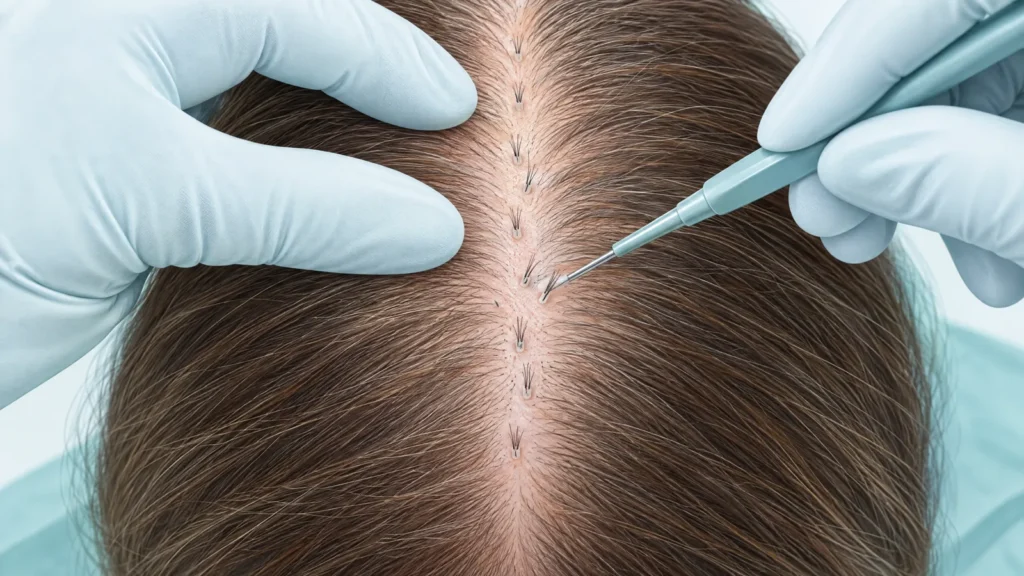
Cover image generated with AI.
A woman may be a candidate for a hair transplant when her hair loss is concentrated in specific areas, such as the parting, hairline or temples, its cause has been assessed, and there is enough healthy donor hair. When hair is thin everywhere, a transplant is often not suitable. Recovery follows broadly the same stages as for men.
This guide explains why the cause of hair loss matters, who is usually a candidate for a female hair transplant in Turkey, what happens at the assessment, how recovery works and what to plan for a stay in Istanbul. It also answers two common questions directly: whether female hair transplants are successful and how long they last.
Why does the cause of hair loss matter for women?
Female pattern hair loss is the most common cause of hair loss in women. A clinical review by Ramos and Miot describes it as a progressive miniaturisation of the hair follicles, which leads to diffuse thinning without scarring, and links it to a mix of genetic, hormonal and environmental factors. The American Academy of Dermatology (AAD) notes that it often shows as a widening parting, that some women also notice receding at the temples, that it runs in families and that it becomes more common after the menopause.
Other conditions can look very similar, so the AAD stresses that a doctor needs to examine the scalp and identify the cause before treatment is planned. For this reason, the doctor may ask for blood tests, for example to check thyroid function and iron stores, to look for other causes of hair loss. If shedding is still active or the cause is not yet clear, the first step is usually to diagnose and manage that, rather than to transplant.
The cause also affects the donor area. Grafts are usually taken from the back of the scalp. Because thinning in women is often diffuse, this area can be affected too, and the AAD points out that when hair is thin all over the scalp, there may not be enough healthy hair to move.
Who is usually a candidate for a female hair transplant?
According to the AAD, both men and women can be candidates, provided they have enough healthy donor hair and can grow hair in the thinning area. A 2021 overview in the Journal of the American Academy of Dermatology lists male and female pattern hair loss as the most common reasons people seek a transplant, but also makes clear that not every hair disorder is suitable for one.
| Often a candidate | Usually not a candidate |
|---|---|
| Thinning concentrated at the parting or crown, with denser hair at the back | Thin hair all over the scalp, including the back and sides |
| A high or receding hairline, or thinning temples | Shedding that is still active or not yet explained |
| Hair loss in a stable scar from surgery or injury | Alopecia areata and some other hair conditions |
| Enough healthy donor hair for the planned area | Too little donor hair for the area to cover |
| Realistic goals for coverage and density | Expecting full density across the whole scalp |
The table is a general guide. Whether a transplant is suitable for you is decided at the examination, after the doctor has looked at the pattern of your hair loss, your donor area and your medical history.
What happens at the assessment?
The assessment usually starts with photos. These give the doctor an initial view of the pattern and the donor area, but the final decision is made at the examination in Istanbul. The doctor looks at how your hair loss is distributed, how dense and healthy the donor area is, the condition of your scalp, your medical history and any treatments you are using, and may ask for blood tests before surgery is confirmed.
If you are a candidate, the next step is to estimate how many grafts the plan needs. Our guide on how many grafts you may need explains how this estimate is made. Many women also prefer not to shave their head. Whether an unshaved hair transplant is possible depends mainly on the number of grafts, and it is decided at the examination.
At Dr. Yetkin Bayer Clinics, grafts are taken with follicular unit extraction (FUE). The hairline is planned by the physician at the examination, together with the patient; ask the clinic who will carry out each stage on the day of the procedure. Dr. Yetkin Bayer is a physician and has been a member of the International Society of Hair Restoration Surgery (ISHRS) since 2016.
Are female hair transplants successful?
For a well-selected woman with localised thinning and enough healthy donor hair, a hair transplant can add visible density to the areas that bother her most, such as the parting, hairline or temples. How well it works depends on the cause of hair loss, the donor area and the planning, so the assessment matters as much as the procedure.
A 2013 review of female hair restoration by Unger describes transplantation as useful in suitable patients for the areas that are most troublesome cosmetically, and sets out planning strategies to reduce unwanted effects after surgery. What a transplant cannot do is create new donor hair or stop female pattern hair loss from progressing, so realistic goals are part of a good outcome.
How long do female hair transplants last?
Transplanted follicles are taken from an area that is less affected by pattern hair loss, and they generally keep the characteristics of that donor area after they are moved. Your surrounding native hair, however, can continue to thin over time, so the plan should allow for future hair loss, not only today’s pattern.
Because female pattern hair loss is progressive, the doctor may also discuss medical treatment to help preserve the hair you already have. The review by Ramos and Miot notes that response to treatment varies, which is one more reason to keep up with follow-up after a transplant.
How does recovery work after a female hair transplant?
The procedure is done under local anaesthesia, and you usually return to your hotel the same day. The first wash is usually done at the clinic between day 1 and day 3. Some people notice mild swelling of the forehead around days 2 to 3, which usually goes down within a few days. Gentle daily washing softens the small crusts around the grafts, and most of them fall off between days 7 and 10. Many people with office jobs return to work after about a week.
- Weeks 2 to 8: the transplanted hairs usually shed. The AAD describes this as normal.
- Around month 3: the AAD notes that hair may look thinner than before the procedure at this stage, which is also normal.
- Months 3 to 4: new hair starts to grow.
- Around month 6: a noticeable difference is often visible. According to the AAD, most people see the result at 6 to 9 months, and some at 12 months.
- Months 9 to 12: the result usually comes close to its final form; the crown can take up to 18 months.
Temporary shedding of existing hair
Some people also lose some of their own existing hair around the treated area for a while after surgery, which is called temporary effluvium. In a 2024 analysis of 621 FUE patients (554 men and 67 women), recipient-site temporary effluvium was recorded in 23 patients, 14 of them women. Female sex was a risk factor in that study, and among women, age was also linked to the risk. As the name suggests, this shedding is temporary, but it helps to know about it in advance so that it does not come as a surprise.
Aftercare in the first month
Heavy exercise and heavy sweating are usually postponed for about a month, as are saunas and swimming pools. Direct sun on the scalp is not recommended in the first weeks. Ask your clinic before you colour your hair or use any other chemical treatment on your scalp. For a closer look at what is expected and what needs attention, see our guide to hair transplant side effects in the first weeks, and for the month-by-month picture, our hair transplant recovery timeline.
Planning a female hair transplant in Istanbul
After the procedure, most people stay in Istanbul for around 2 to 3 nights, which allows for the first check and wash at the clinic before the flight home. For international patients, the package includes:
- Medical care: the consultation and medical examination, pre-operative tests and the procedure itself.
- Stay and transport: three nights in a hotel, airport transfers and transport within Istanbul.
- Aftercare: medication and the first wash.
Flights are not included. After your photos have been reviewed, you receive a written, itemised quote. The clinic is in Ulus, Beşiktaş, and holds the Turkish Ministry of Health’s International Health Tourism Authorisation Certificate (ST-2237). If you are comparing clinics, our 12 checks before you choose a clinic may help you decide which questions to ask.
If you would like an initial view of whether you may be a candidate, you can send photos of your hairline, parting and donor area through our consultation form.
Frequently asked questions
Can a woman with thinning all over the scalp have a hair transplant?
Often not. When hair is thin everywhere, including the donor area, there may not be enough healthy hair to move, and the first step is to find the cause of the hair loss.
Will I need to shave my head for a female hair transplant?
Not necessarily. Whether an unshaved approach is possible depends mainly on how many grafts you need, and this is decided at the examination.
Do I need blood tests before a female hair transplant?
Your doctor may ask for blood tests, for example to check thyroid function and iron stores, to help find the cause of hair loss before surgery is planned.
Is temporary shedding more common in women after a hair transplant?
In one 2024 study of FUE patients, female sex was a risk factor for temporary shedding at the recipient site. The shedding is temporary, and your clinic can explain what to expect.
How long should I stay in Istanbul for a female hair transplant?
Most people stay around 2 to 3 nights after the procedure. This allows for the first check and wash at the clinic before flying home.
Sources
- American Academy of Dermatology. Thinning hair and hair loss: could it be female pattern hair loss? AAD
- American Academy of Dermatology. Hair loss treatment: hair transplant. AAD
- Ramos PM, Miot HA. Female pattern hair loss: a clinical and pathophysiological review. Anais Brasileiros de Dermatologia. 2015. PubMed
- Unger RH. Female hair restoration. Facial Plastic Surgery Clinics of North America. 2013. PubMed
- Okochi H, Onda M, Momosawa A, Okochi M. An analysis of risk factors of recipient site temporary effluvium after follicular unit excision. Aesthetic Plastic Surgery. 2024. PubMed
- Jimenez F, Alam M, Vogel JE, Avram M. Hair transplantation: basic overview. Journal of the American Academy of Dermatology. 2021. PubMed

This article is for general information only and does not replace a medical examination. Results vary from person to person; please consult your physician before any procedure.
