
Cover image generated with AI.
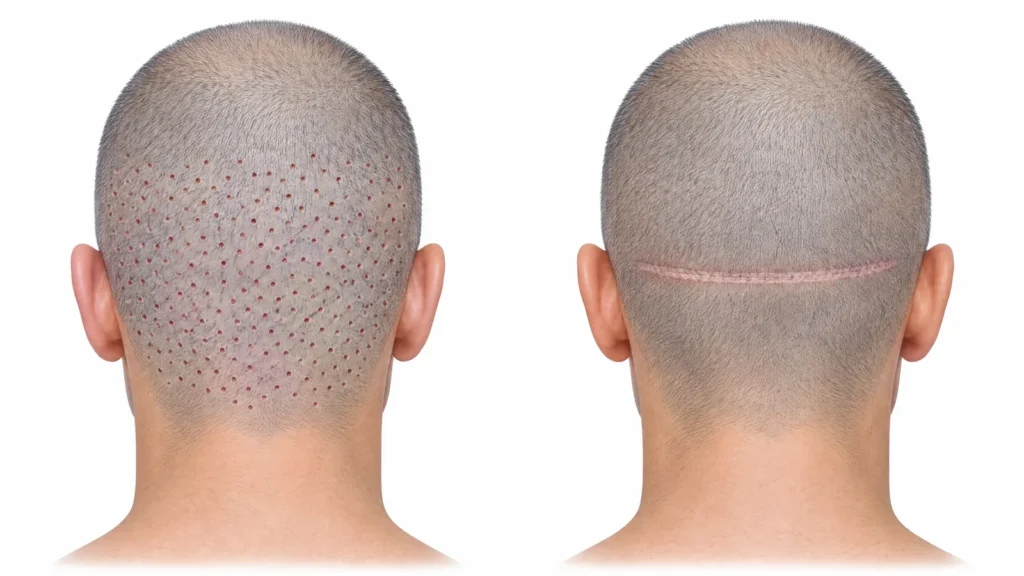
FUE and FUT are two ways of taking grafts from the donor area. FUT removes a thin strip of skin and leaves one linear scar, while FUE takes follicles one by one and leaves many small dot-like scars. Both provide good-quality grafts, so the choice depends on your donor area, your hairstyle and your future plans.
This guide to FUE vs FUT explains how each method works, compares scars, shaving, healing and suitability in a table, and looks at how the choice affects later sessions. It also explains why FUE vs FUT is a different question from FUE vs DHI.
How does FUT, the strip method, work?
In follicular unit transplantation (FUT), often called the strip method, a thin strip of skin is removed from the back of the head. As the NHS describes it, the strip is then divided into small grafts of one to four hairs each, and the area it came from is closed with stitches.
With FUT the head is not shaved; only the strip area is trimmed. The method leaves a scar at the back of the head, which, according to the NHS, is not visible unless the hair is cut very short. This means that, for people who wear their hair longer, the donor area can stay covered from the start.
How does FUE work?
In follicular unit extraction (FUE), also called follicular unit excision, hairs are removed one at a time. The NHS describes the back of the head being shaved first and the follicles then being taken individually. Instead of a single line, FUE leaves many small scars spread across the donor area, which the NHS says are hardly noticeable.
FUE is also what makes it possible to use beard or body hair as an extra donor source when the scalp donor area is limited, as a 2013 review by Umar explains. Our guide to body hair transplant covers when that may be considered and who it may suit.
FUE vs FUT at a glance
Both are established ways of harvesting grafts, and a 2021 review of surgical technique in the Journal of the American Academy of Dermatology describes graft harvesting with both FUT and FUE. A 2020 comparison by Gupta and colleagues found that FUT and FUE are equally effective in terms of graft quality; what differs most is the shape of the donor scars. This is how they compare in practice:
| Factor | FUE | FUT |
|---|---|---|
| Scar pattern | Many small dot-like scars, usually easy to hide | One linear scar at the back of the head |
| Shaving | Back of the head shaved | Not shaved; only the strip area trimmed |
| Donor healing | Many tiny extraction points | One stitched wound along the strip |
| Very short hair | Small scars are hardly noticeable | The scar may show |
| May suit | Short hairstyles; beard or body hair as extra donor | Longer hair; those who prefer not to shave |
| Later sessions | Grafts come from across the donor area, so remaining density matters | Any later harvest takes the existing scar into account |
Which technique fits your donor area?
A 2022 review by Memon and Avram concludes that the pros and cons of FUE and FUT should be weighed for each patient. Gupta and colleagues reach a similar view: some groups of patients are better suited to FUE, some to FUT and some to either. These are the points that usually shape the choice:
- How you wear your hair: if you keep it very short, a linear scar may show, whereas the small scars from FUE are hardly noticeable. If you wear it longer, a FUT scar is usually covered.
- Shaving: FUE usually means shaving the back of the head, while with FUT only the strip area is trimmed.
- Donor density and size: how many grafts your donor area can give, and how that supply should be shared out over time.
- How many grafts you need, now and later: the size of the thinning area and the chance of further hair loss decide how much of the donor area the plan uses. Our guide on how many grafts you may need explains how this is estimated.
- Extra donor sources: if beard or body hair may be needed, FUE is the method used to harvest it.
- Your own priorities: how you feel about a single line compared with many small marks, and about shaving.
A note on women
In women, thinning is often spread across the crown and temples, and many women want to keep their hair long. A 2025 review of 24 studies by Queen and Avram found that women more often choose FUT, because it helps preserve the donor area and fits well with long hair. The same review stresses that the approach should be tailored to each woman.
How does the choice affect later sessions?
Your donor area is limited, and grafts used today cannot be used again later. If your hair loss continues, or if a large area is treated in stages, the plan has to leave enough donor hair for a later session. The NHS notes that larger areas may need two or more sessions on different days.
With FUE, grafts are taken from across the donor area, so what matters for a later session is how much density remains between the earlier extraction points. With FUT, any later harvest has to take the existing scar into account. In both cases the useful question to ask at your assessment is the same: how much donor hair will be left once this plan is complete? If both the front and the crown are thinning, our guide to planning a crown hair transplant explains why the front usually comes first and how grafts are kept in reserve.
FUE vs FUT is not the same question as FUE vs DHI
FUE and FUT describe how grafts are taken out of the donor area. DHI describes how they are put in: the grafts are placed with an implanter pen. The 2021 surgical technique review lists the main placement options side by side, namely channels opened beforehand, stick-and-place and implanters.
So the two comparisons answer different questions. Our article on whether FUE or DHI suits you covers placement, and our page on the oblique channel technique explains how the channels for the grafts are opened.
What are the risks of each method?
Both methods are surgery, and both leave scars; what differs is their shape. The NHS lists bleeding, infection and an allergic reaction to the anaesthetic among the risks of a hair transplant, mentions small scars, and notes that a transplant may not take.
A 2025 scoping review of complications in modern hair transplantation found that serious complications are rare in experienced hands. It lists long-lasting numbness, infection and temporary shedding in the donor or recipient area among the problems reported, and for FUT it reports hypertrophic scarring, where the scar becomes raised and thickened. How visible a donor scar becomes depends on how your skin heals, the technique and how short you keep your hair, so if you have had raised or thickened scars before, mention it at your assessment.
How we work at Dr. Yetkin Bayer Clinics
Our clinic works with FUE. The hairline is planned by the physician at the examination, together with the patient, and the choice of donor method is explained at the same visit. FUT remains an established method with its own place, and the reviews above support weighing the two for each patient.
Whichever clinic you see, the NHS suggests asking which method is recommended for you and why. A clear answer, based on your donor area and the way you wear your hair, shows that the plan has been made for you.
If you would like to know how your donor area looks for FUE, you can send photos of the back and sides of your head, along with the thinning area, for an online assessment through our consultation form.
Frequently asked questions
Does FUE leave scars?
Yes. FUE leaves many small scars across the donor area, which the NHS describes as hardly noticeable. How visible they are depends on healing and on how short you wear your hair.
Will people see a FUT scar?
FUT leaves a linear scar at the back of the head. According to the NHS, it is not visible unless the hair is cut very short.
Do FUE and FUT give the same graft quality?
A 2020 comparison found that both methods provide good-quality grafts and are equally effective in that respect. The main difference is the shape of the donor scars.
Why do some women choose FUT?
A 2025 review found that women more often choose FUT because it helps preserve the donor area and fits well with long hair. The approach should still be tailored to each person.
Is FUE the same as DHI?
No. FUE is a way of extracting grafts, while DHI is a way of placing them with an implanter. The two terms answer different questions.
Sources
- NHS. Hair transplant. nhs.uk. Page last reviewed 29 September 2023. NHS website
- Gupta AK, Love RP, Harris JA. Old friend or new ally: a comparison of follicular unit transplantation and follicular unit excision methods in hair transplantation. Dermatologic Surgery. 2020. PubMed
- Memon R, Avram M. The pros and cons of follicular unit extraction (FUE) versus elliptical donor harvesting (FUT). Journal of Cosmetic and Laser Therapy. 2022. PubMed
- Jimenez F, Vogel JE, Avram M. CME article Part II. Hair transplantation: surgical technique. Journal of the American Academy of Dermatology. 2021. PubMed
- Queen D, Avram MR. Hair transplantation in women. Journal of Drugs in Dermatology. 2025. PubMed
- Liu RH, Xu LJ, McCarty JC, et al. A scoping review on complications in modern hair transplantation: more than just splitting hairs. Aesthetic Plastic Surgery. 2025. PubMed
- Umar S. Use of body hair and beard hair in hair restoration. Facial Plastic Surgery Clinics of North America. 2013. PubMed

This article is for general information only and does not replace a medical examination. Results vary from person to person; please consult your physician before any procedure.
