
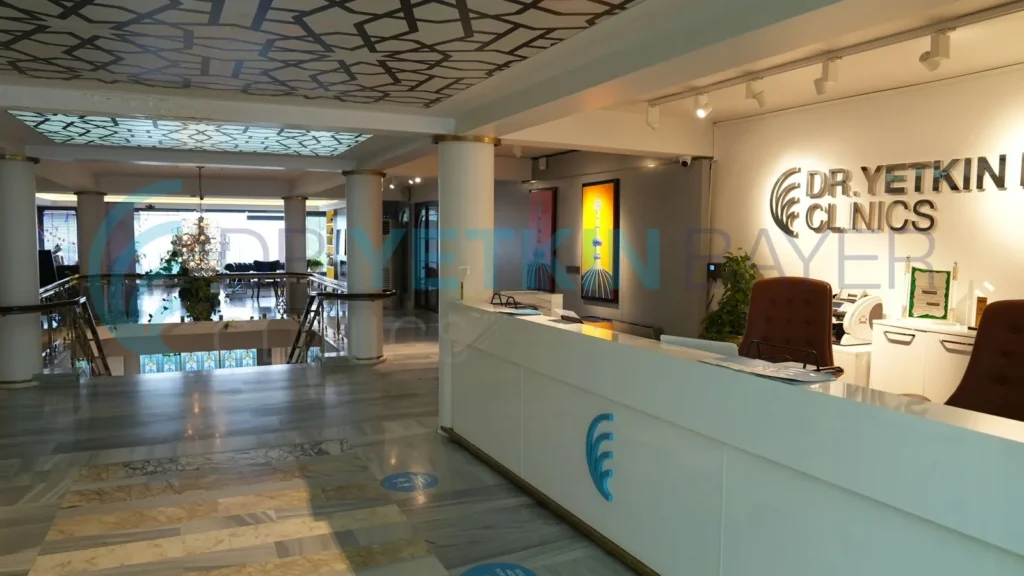
The hair transplant Turkey package at Dr. Yetkin Bayer Clinics in Istanbul includes consultation and medical examination, pre-operative tests, the procedure, three hotel nights, airport transfers and transport within Istanbul, medication and the first wash. Flights are not included. After your photos have been reviewed, you receive a written, itemised quote.
Below you will find what the package covers and what to ask about in writing, a typical stay in Istanbul day by day, who does each stage of the procedure, how the method and graft numbers are chosen, what affects the price and what recovery usually looks like.
What is included in the package?
For international patients, the package covers the medical side of your stay and the practical arrangements in Istanbul:
- Consultation and medical examination: an in-person assessment of your hair loss, scalp and donor area before the procedure, including your health history and the medicines you take.
- Pre-operative tests: the tests needed before surgery.
- The procedure: the hair transplant itself, with the method agreed at your assessment.
- Three hotel nights: accommodation for your stay in Istanbul.
- Airport transfers and transport within Istanbul: pick-up at the airport, transport between the hotel and the clinic, and the transfer back for your flight home.
- Medication: the medicines your physician prescribes for the first days after the procedure.
- The first wash: usually done at the clinic between day 1 and day 3, together with a check of the treated areas.
The written, itemised quote lists each of these items, so you can see what is covered before you book anything.
What is not included, and what should you ask about in writing?
Flights are not included in the package; you book them separately. Packages are sometimes called “all-inclusive”, but their contents vary between clinics, so compare quotes item by item. These points are worth raising before you book, so that the answers appear in your written plan:
- Extra nights: if you want to arrive earlier or stay longer than three nights, ask how this changes your quote.
- A companion: if a friend or family member is travelling with you, ask whether the room and transfers cover them.
- The hotel stay: ask what kind of room is booked and whether meals are part of it.
- Follow-up after you go home: ask how your recovery will be followed, for example through photo check-ins, and who to contact if you have a question.
- Further sessions: the NHS notes that large areas may need two or more sessions on different days, so ask whether this could apply to you and how it would be planned.
Step by step: from your first photos to the flight home
- Photos and online assessment: you send photos of your hair loss and donor area through the consultation form.
- Written plan and quote: after the photos have been reviewed, you receive a written plan and an itemised quote.
- Dates and flights: you agree the dates with the clinic and book your own flights.
- Your stay in Istanbul: as in the table below.
- Recovery at home: you follow your written aftercare and send photos if anything looks unexpected.
A typical programme in Istanbul
Most international patients follow a similar pattern. The exact days, including whether the examination and the procedure fall on the same day, depend on your plan.
| Day | What usually happens | In the package |
|---|---|---|
| Arrival day | Pick-up at the airport and transfer to your hotel | Airport transfer, hotel |
| Procedure day | Examination and tests, often on the same day depending on your plan, then the procedure under local anaesthesia; back to the hotel the same day | Examination, tests, procedure, transport, medication |
| Day after: first wash and check | First wash and a check at the clinic | First wash, transport |
| Travel home | Transfer to the airport, usually after two to three nights in Istanbul following the procedure | Airport transfer |
This is a typical pattern, not a fixed timetable: your written plan confirms the exact days.
How is the procedure carried out, and who does each stage?
A hair transplant is surgery, carried out under local anaesthesia; the NHS says it usually takes a day. With follicular unit extraction (FUE), grafts are taken one by one from the donor area, usually the back and sides of the head, and placed into small channels opened in the thinning area. A 2021 review of surgical technique in the Journal of the American Academy of Dermatology describes the main ways of placing grafts: into channels opened beforehand, with a stick-and-place approach, or with an implanter.
The hairline is planned by the physician at the examination, together with the patient. The channels can be opened with the oblique channel technique, in which each channel is angled to follow the natural direction of hair growth.
The International Society of Hair Restoration Surgery (ISHRS) stresses that hair restoration in any form is surgery, and that examination, diagnosis, planning, the procedure and the management of complications should be carried out by a physician. Whichever clinic you choose, ask who will carry out each stage on the day.
FUE, DHI or unshaved: which method?
The method is chosen at your assessment, based on the area to be treated, the number of grafts and your donor hair.
- FUE with channels: grafts are extracted one by one and placed into channels opened beforehand. The NHS notes that FUE leaves many small scars, which are not usually very noticeable.
- DHI: grafts are placed with a pen-like implanter, without opening each channel separately first. Our page on DHI hair transplant in Turkey explains how it works, and our article on how FUE and DHI compare sets the two side by side.
- Unshaved: in some people, the transplant can be done without shaving the whole head. Whether this suits you depends on the size of the area, the number of grafts and your donor area; see our page on unshaved hair transplant in Turkey.
How is the number of grafts decided?
The number of grafts depends on the area you want to cover, the density you hope for and how many grafts your donor area can supply. An estimate made from photos is a range; it is confirmed at the examination in Istanbul.
Planning also has to look ahead. The NHS points out that hair around the transplanted area may keep thinning, so the design should leave room for future hair loss. It also notes that a transplant suits hereditary baldness but is not usually suitable for conditions such as alopecia areata, which is why the cause of your hair loss is checked first. Our guide to how many grafts you may need explains how estimates are made.
What affects the price of a hair transplant in Turkey?
There is no single price, because each plan is different. These factors usually shape a quote:
- The size of the area: restoring a hairline is a different plan from treating the front and the crown together.
- The number of grafts: set by the area to be covered and your donor supply.
- The method: FUE with channels, DHI or unshaved, chosen for your case.
- Your donor area: the density and type of your hair affect the planning.
- Your stay: extra nights or a companion can change the quote; flights are always separate.
When comparing quotes, look at what each one includes and who carries out each stage, not only at the total. The NHS suggests asking about the surgeon’s qualifications, how many procedures they have carried out, including how many had complications, which method they recommend and why, and what follow-up there will be if something goes wrong. It also explains that in England, independent providers of cosmetic surgery must be registered with the Care Quality Commission; in Turkey, ask for the clinic’s Ministry of Health authorisation certificate. Our 12 checks for choosing a hair transplant clinic in Turkey go through these questions in more detail.
What does recovery usually look like?
The NHS describes the scalp as feeling tight, sore and swollen for a few days, with temporary scabbing where the grafts were placed, and notes that the grafts are not fully settled in the first two weeks.
- Days 1 to 3: the first wash, usually at the clinic. Some people notice mild swelling of the forehead around days 2 to 3, which usually goes down within a few days.
- Days 7 to 10: with gentle daily washing, most crusts soften and fall off.
- About a week: many people with office jobs return to work; the NHS notes you may need one to two weeks off.
- The first month: heavy exercise, sweating, saunas and swimming pools are usually put off for about a month, and direct sun on the scalp is not recommended in the first weeks.
- Weeks 2 to 8: many of the transplanted hairs shed; this is temporary.
- Months 3 to 4: new hair starts to grow, and a clear difference is usually visible by month 6.
- Months 9 to 12: the result usually approaches its final appearance; the crown can take up to 18 months. The NHS gives 10 to 18 months for full results.
The NHS lists bleeding, infection and an allergic reaction to the anaesthetic among the risks, and notes that a transplant may not take. Pain that keeps increasing, spreading redness, warmth, discharge or a fever are reasons to contact the clinic straight away. Our overview of hair transplant side effects explains what is usually normal in the first weeks, and the hair transplant recovery timeline follows the months that come after.
About Dr. Yetkin Bayer Clinics
Dr. Yetkin Bayer is a physician who graduated from Trakya University Faculty of Medicine and began working in hair transplantation in the United States in the mid-1990s. He has been a member of the ISHRS since 2016. The clinic is in Ulus, Beşiktaş, Istanbul, and holds the Ministry of Health International Health Tourism Authorisation Certificate ST-2237. The Ministry has also authorised the clinic’s hair transplant training programme, approved in 2025.
If you would like a written plan and an itemised quote for your own case, you can send photos of your hair and donor area for an online assessment through our consultation form.
Frequently asked questions
What is included in a hair transplant package in Turkey?
At our clinic, the package includes consultation and medical examination, pre-operative tests, the procedure, three hotel nights, airport transfers and transport within Istanbul, medication and the first wash. Contents vary between clinics, so always ask for a written, itemised quote.
Are flights included in the hair transplant package?
No. Flights are not included and are booked separately. The written quote lists everything that is included.
How long do I need to stay in Istanbul for a hair transplant?
You usually stay two to three nights after the procedure, which leaves time for the first wash and a check. The package includes three hotel nights, and your written plan confirms the exact days.
Who plans and carries out a hair transplant?
The hairline is planned by the physician at the examination, together with the patient. Ask the clinic to explain, stage by stage, who will carry out each step on the day; the ISHRS stresses that the surgical steps should be carried out by a physician.
Can I get a price without sending photos?
No. A quote is given after your photos have been reviewed, because the number of grafts and the method depend on your own hair loss and donor area.
Sources
- NHS. Hair transplant. nhs.uk. Page last reviewed 29 September 2023. NHS website
- International Society of Hair Restoration Surgery (ISHRS). Consumer alert. ishrs.org
- Jimenez F, Vogel JE, Avram M. CME article Part II. Hair transplantation: surgical technique. Journal of the American Academy of Dermatology. 2021. PubMed

This article is for general information only and does not replace a medical examination. Results vary from person to person; please consult your physician before any procedure.


