
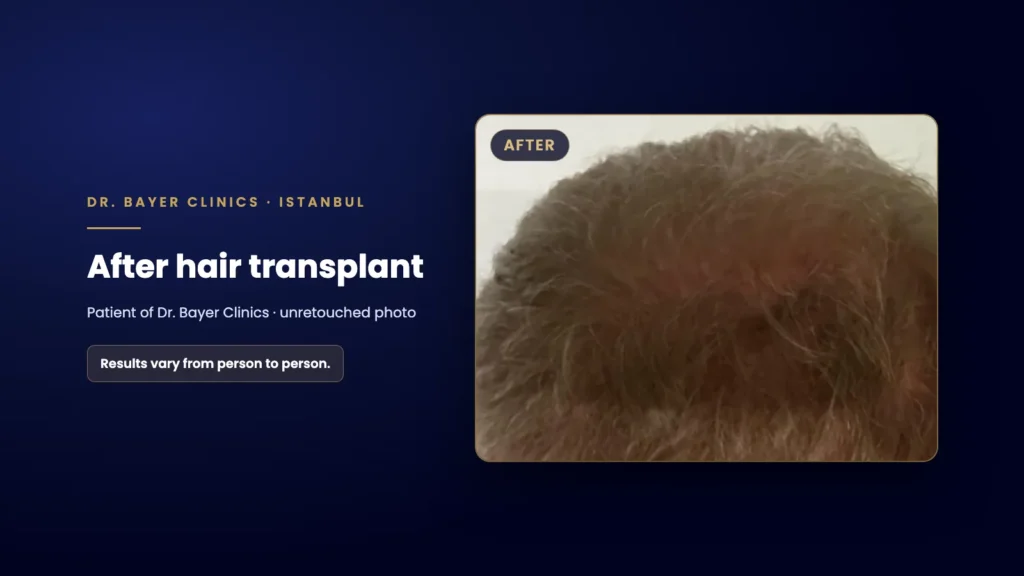
A crown hair transplant restores thinning at the vertex, where hair grows outwards from a spiral. It is planned differently from the hairline: the grafts must follow the spiral, the area can keep widening with future hair loss, and the front and mid-scalp usually come first. Crown results can also take up to 18 months to mature.
This guide explains what makes the crown different, how the spiral direction and the spread of grafts are planned, why the front usually comes first, how donor reserve and future hair loss shape the plan, and why crown results take longer. A table compares the front and the crown side by side.
What is the crown, and why is it different?
The crown, or vertex, is the area towards the back of the head where the hair forms a whorl: a point from which hairs grow outwards in a spiral, clockwise or anticlockwise. Some people have more than one whorl. In men, pattern hair loss can affect the hairline and temples, the crown, or both, and a thinning crown often begins as a small patch that slowly widens over the years.
In a 2013 review on the management of the crown, Devroye describes it as an area whose anatomical features create challenges of their own. A natural result and good visible density there call for managing the crown in its own way and choosing the technique to match. In other words, the crown is not simply more scalp behind the hairline, and a plan that treats it that way can disappoint.
How is the spiral direction recreated?
At the hairline, hairs point forwards and lie at a low angle to the scalp. In the crown, the direction changes all the way around the whorl, so each graft has to point the way the hair around it grows. Grafts placed against the spiral can stand out from the surrounding hair or create a parting where you do not expect one.
The angle and direction of each hair are set when the channels are opened, so this is the step where the spiral is recreated. Our article on the oblique channel technique explains why the angle of each channel matters. Before the procedure, ask who will open the channels in the crown and how the angles will be planned.
A 2021 review of surgical technique in the Journal of the American Academy of Dermatology describes the different ways grafts can be placed, from channels opened beforehand to implanters. Our comparison of FUE and DHI explains how those approaches differ.
How are grafts spread across the crown?
The crown is usually seen from above and behind, often under overhead light, and its hair fans out from the whorl instead of overlapping in one direction. This means the scalp can show through more easily than at the front, even when the number of grafts is similar. A crown plan therefore decides where the available grafts will make the most visible difference and how the transplanted area will blend into the hair around it. The main points are:
- Size of the area: how far the thinning reaches now, and how far it may spread.
- Direction: the spiral pattern that each graft has to follow.
- Blending: how the edges of the transplanted area meet your own hair, where thinning may continue.
- Your hair: its thickness and its colour against your skin can change how full the area looks.
- Reserve: how many grafts to keep back for the front, or for the crown itself, in the future.
How many grafts do you need for the crown?
There is no fixed number. It depends on the size of the area, how much hair is still growing there and how many grafts your donor area can provide, now and later. A first estimate can be made from clear photos, and it is then confirmed at examination.
Our guide on how many grafts you may need sets out typical ranges by stage of hair loss on the Norwood scale and explains how estimates are made, so we will not repeat them here.
Why does the front usually come first?
When both the front and the crown are thinning, the donor area may not be able to cover everything at once, so the plan has to set priorities. Usually the front and mid-scalp are treated first, because they frame the face and are what you and other people notice most. The crown is then treated in a second session if it is still needed and the donor area allows.
This order also leaves room for change. The NHS points out that hair around a transplanted area can continue to thin, so the design should allow for future hair loss. That matters in the crown, where a thinning patch can keep widening. Treating the front first, then looking at the crown again once you can see how your hair loss is progressing, keeps grafts in reserve for the area that needs them most. The NHS also notes that larger areas may need two or more sessions on different days.
Donor reserve and future hair loss
Your donor area, usually the back and sides of the head, is limited, and grafts used today cannot be used again later. A crown plan therefore has to answer three questions: how much the crown needs now, how much the front may need in future, and how much donor hair will be left if your hair loss continues.
- Suitability: the American Academy of Dermatology (AAD) notes that a transplant needs enough healthy donor hair and a thinning area that is still able to grow hair.
- Continuing hair loss: hair loss in the crown can continue after the procedure, so the plan should still make sense if it does.
- Edges that may thin: transplanted hair in the crown can end up surrounded by thinning hair, so the plan considers how the area will look if that happens.
- Front and crown together: spreading the donor supply too thinly across both areas can leave neither looking as full as you hoped.
A careful plan sometimes means a smaller crown session than you expected, or advice to wait. That is part of planning for the long term, not a sign that the crown cannot be treated.
Front and crown compared
The table summarises how the two areas differ when a transplant is planned.
| Factor | Front and hairline | Crown (vertex) |
|---|---|---|
| Hair direction | Forwards, at a low angle | Outwards in a spiral from the whorl |
| Visible density | Hair lies in one direction and overlaps | Hair fans out, so the scalp can show through |
| Time to result | Usually close to final at 9–12 months | Can take up to 18 months |
| Priority | Usually treated first | Often a second session, if needed |
| Future thinning | Hair behind the hairline may keep thinning | The thinning patch can keep widening |
Why do crown results take longer?
The early stages are the same everywhere. The transplanted hairs usually shed between weeks 2 and 8; the AAD calls this normal and adds that around month 3 the hair may look thinner than before the procedure, which is also normal. New hair usually starts to grow from around months 3 to 4, and by month 6 most people can see a clear difference.
The difference comes later. At the front, the result usually comes close to its final look between months 9 and 12. In the crown, the process can take up to 18 months. The NHS gives 10 to 18 months for full results in general, and the AAD notes that most people see results in 6 to 9 months, while for some it takes 12 months. Crown results tend to sit at the later end of these ranges.
Part of the reason is visual. Because the hair in the crown spreads out from the whorl and is mostly seen from above, it needs more length before it covers the scalp, so early growth is harder to notice than at the hairline, where even short hairs frame the face. Judging the crown at month 6, or even at month 12, can be too early.
For month-by-month detail, see our hair transplant recovery timeline.
What to discuss at your assessment
- The order of treatment: whether the front, the crown or both are planned, and over how many sessions.
- Direction: how the spiral will be recreated, and who opens the channels.
- Donor reserve: how many grafts would be left for the future.
- Timeline: when to expect visible change in the crown, and when it is fair to judge the result.
- Cost: how a second session would affect the overall cost. Our guide to what drives the price of a hair transplant explains the factors behind a quote.
If your crown is thinning and you would like a first view of what may be possible, you can send photos of your hairline, your crown and your donor area for an online assessment through our consultation form.
Frequently asked questions
How many grafts do you need for the crown?
It depends on the size of the area, how much hair is still growing there and what your donor area can provide. A first estimate can be made from photos and is then confirmed at examination.
Why do crown results take longer?
The crown can take up to 18 months to reach its final look, compared with around 9 to 12 months at the front. The NHS gives 10 to 18 months for full results in general.
Can the front and the crown be done in one session?
Sometimes, if the donor area allows. Usually the front and mid-scalp are treated first and the crown follows in a second session if needed; the NHS notes that larger areas may need two or more sessions.
What if my crown keeps thinning after the transplant?
Hair around a transplanted area can continue to thin, so the plan should allow for this from the start. Keeping donor grafts in reserve leaves options for later.
Is the technique different for the crown?
The steps are the same, but each graft has to follow the spiral direction of the whorl. A 2013 review describes the crown as needing its own management and choice of technique.
Sources
- Devroye J. Management of the crown. Facial Plastic Surgery Clinics of North America. 2013. PubMed
- NHS. Hair transplant. nhs.uk. Page last reviewed 29 September 2023. NHS website
- American Academy of Dermatology. Hair loss treatment: hair transplant. aad.org
- Jimenez F, Vogel JE, Avram M. CME article Part II. Hair transplantation: surgical technique. Journal of the American Academy of Dermatology. 2021. PubMed

This article is for general information only and does not replace a medical examination. Results vary from person to person; please consult your physician before any procedure.
